
WA Primary Health Alliance supports communities across Western Australia by strengthening general practice and primary care services to remain accessible and responsive before, during and after disasters.
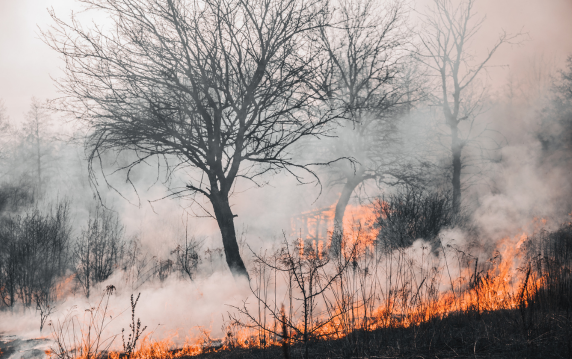
General practice can play a vital role in disaster prevention, preparedness, response and recovery by maintaining continuity of care at a time when communities need it most.
Role of Primary Health Networks in disaster
Recognising the significant impact that disaster has had on the community in recent years, from COVID-19 to severe flooding and bushfires, and the role that primary care has in supporting affected communities prior to, during and after disaster, primary care providers need resilience in times of disaster in order to ensure continuity of care and effective recovery from disaster.
The Australian Government Department of Health, Disability and Ageing has highlighted the important role of Primary Health Network’s (PHN) in emergency preparedness, especially in terms of the responsibility to build primary care capacity to manage emergency preparedness, planning and coordination.
PHNs are well positioned to support general practice and the primary care workforce in building capacity to navigate disasters due to their connections to local services and government agencies. PHNs can coordinate an efficient response and share emergency management information from the relevant Hazard Management Agencies during and after disasters.
eLearning: Building Capacity in Disaster Preparedness and Response for General Practice
WA Primary Health Alliance
These comprehensive eLearning modules are specifically designed to enhance participants’ knowledge and understanding of key emergency management principles and practices in Western Australia.
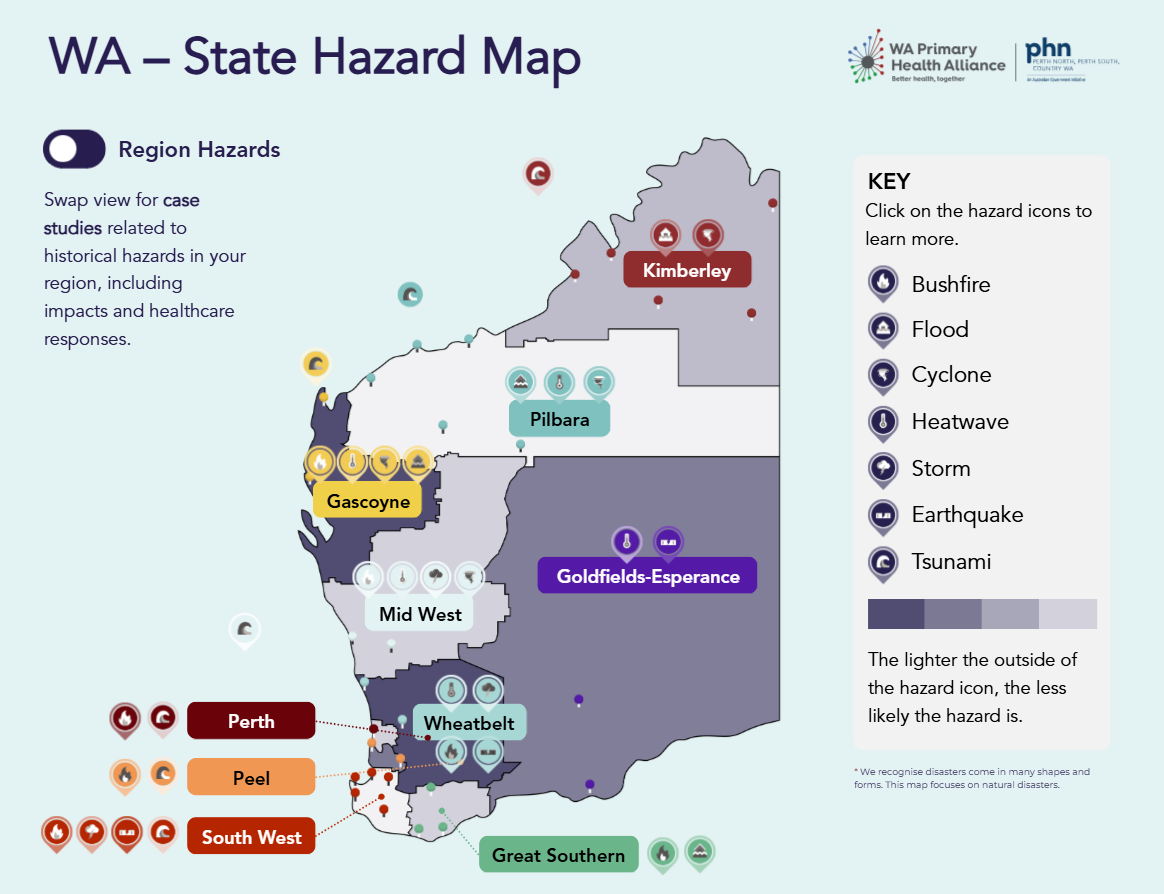
What participants will learn:
- Practical strategies for disaster preparedness, response, and recovery in primary care.
- Maintaining continuity of care and managing patient demand during crises.
- Resource prioritisation and supporting priority populations.
- Coordinating with local health districts, emergency services, and public health agencies.
- Building practice resilience, safety systems, and structured disaster management processes.
Incentives:
- The modules are available to all practices and will offer RACGP Continuing Professional Development (CPD) hours and other CPD options for other health professions.
- Get your practice prepared for disaster to minimise the impact it will have on the business during disaster and maintain business continuity.
- Meet RACGP standards for general practice, which will support you in your practice accreditation.
The General Practice Emergency Response Team (GPERT) strengthens disaster preparedness, response and recovery by formally integrating general practice into emergency response systems across Western Australia.
WA Primary Health Alliance has initiated a project to explore the role of general practice in disaster scenarios and identify how primary care can be optimally positioned to provide support.
The GPERT project was established in response to the known and ongoing risks that disasters pose to communities served by general practice. The model aims to address the challenges faced by GPs during such events and enhance their capacity to deliver high-quality care in times of crisis.
A key component of the model includes the formation of the General Practice Emergency Response Team, a voluntary team of primary care health professionals able to provide support during and after a disaster.
Examples of such responses include assisting during natural disasters – such as cyclones, floods, or bushfires – or providing support following mass injury or casualty incidents. This may involve offering services within general practice clinics, mobile practices, evacuation centres, or by extending general practice hours to ensure greater access to primary care services where and when people need them most.
If you are interested, please complete the EOI survey (coming soon). The purpose of the survey is to help us understand the interest of general practice teams and individual practitioners. Please note that expressing interest now does not commit you to participation later. We would like to understand your experience in this area as well as your estimated availability to participate.
This role is voluntary, so remuneration arrangements may vary and will depend on the nature and timing of any activation, as well as funding provided by the Department of Health, Disability and Ageing or other funding bodies.
Expression of interest survey coming soon.
- Must hold current registration with the relevant health professional board or authority in Australia.
- Demonstrate experience in primary care practice, with the ability to provide patient-centred care during emergencies.
- Be prepared to maintain continuity of care and support the local community when regular services are disrupted.
- Commit to opening their clinic or providing services as appropriate, subject to their own availability and personal circumstances.
- Ability to travel (if able and willing) to impacted location statewide with potentially minimal notice.
- Participate in disaster response training and be familiar with local emergency management procedures.
- Have access to necessary medical supplies, equipment, and communication tools to operate effectively during a disaster.
- Maintain clear and timely communication with WAPHA and other stakeholders throughout the response period.
- Respect privacy, confidentiality, and ethical obligations, even in challenging circumstances.
- Ensure that appropriate professional indemnity and public liability insurance cover is maintained for all activities undertaken as part of the disaster response, including clinic operations and patient care during emergencies. Volunteers are responsible for confirming with their insurer that their participation is covered under their existing policies, and for seeking additional coverage if required.
The GPERT project is dependent on a diversity of contributions that can reflect and contextualise WA’s health care needs in disaster. Please e-mail the Disaster Preparedness Team to register your interest for updates on ongoing project work at disasterpreparednessteam@wapha.org.au. Click below to expand for more.
Click below to expand for more.
- My Health Record
- Electronic Prescriptions
- Telehealth and Virtual Care
- Healthdirect
View our toolkit: Digital Health – PracticeAssist
- Aged Care Quality Standards – Aged Care Quality and Safety Commission
- Ageing Australia: Emergency preparedness planning
- Person-Centred Emergency Preparedness (PCEP) User Guide
- NEMA: Emergency Management Capabilities for DIDRR
- Carers WA Bushfire Plan: Emergency Disaster Checklist
- Australian Red Cross: Emergency Preparedness Guide
- Building capacity in general practice for disaster preparedness and response | WAPHA
- Emerging Minds Learning – Supporting children and families in general practice after a natural disaster or community trauma.
- The Disaster Mental Health Hub | phoenixaustralia.org